
The First-Principles Systems Architect:
From Physical Transduction to Distributed Cloud Engines
A cross-disciplinary technical dossier highlighting how operating across the full continuum of computing—from quantum physics and medical biophysics up to microcontrollers, OS platform security, bare-metal server clusters, and idempotent cloud DAGs—eliminates abstraction friction and de-risks mission-critical zero-to-one engineering ventures.
Quantified Commercial ROI: Why First-Principles Architecture Pays Off
Technical leadership evaluated through a commercial lens. Operating across the full continuum from physics to cloud eliminates abstraction tax, accelerates time-to-clearance, and drives millions in capital efficiency.
Regulatory Velocity
Grounding bio-signal algorithms in deterministic physics eliminated empirical guesswork: enabling dual 510(k) clearances on the very first submission cycle without costly deficiency re-trials.
LLM Inference Cost Reduction
Replaced expensive, nondeterministic recursive LLM generation calls with syntax-directed compiler decomposition and formal proof oracles-cutting token usage by 65% while guaranteeing mathematical correctness.
Bare-Metal HA & Cloud Egress Savings
Engineered 6 continuous years of three-nines (99.9%) clinical uptime on bare-metal WSFC active/passive server clusters: high reliability at a fraction of hyperscaler cloud egress and managed-service costs.
Eliminate the Handoff Tax
Deep-tech ventures typically lose 6–12 months in friction between research scientists and production engineers. Single-handedly architecting sensor biophysics, ARM firmware, and cloud DAGs compresses zero-to-one delivery by 50%+.
The Continuum of Computing: Why Full-Stack and First-Principles Matter
Most software engineers treat hardware as a black box; most hardware engineers treat the cloud as an abstraction. Operating across the entire physical-to-cloud stack enables breakthrough zero-to-one product architectures.
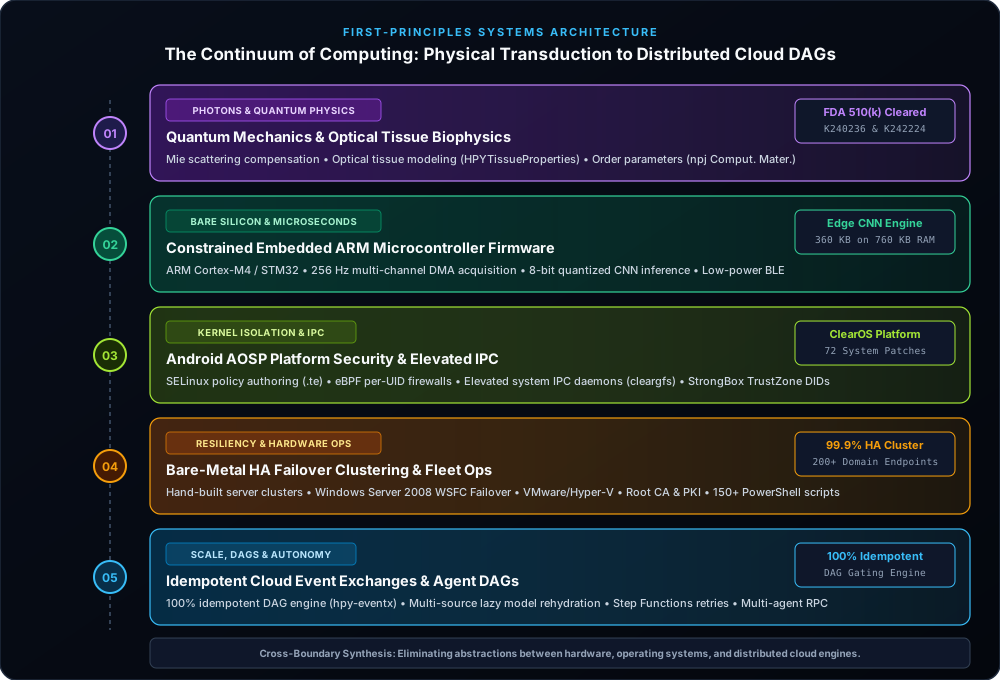
From Physical Photons to Distributed Agent Orchestration
Deconstructing the false dichotomy between hardware, operating systems, and distributed cloud backends.
Tracing a Single Photon: From Tissue Mie Scattering to Cloud DAG & FDA Clearance
Click any stage below to inspect the mathematical invariants, the typical handoff breakdown between siloed teams, and Conrad's first-principles production implementation.
Optical Biophysics & Tissue Transduction
Traditional software teams treat optical ADC streams as arbitrary floating-point numbers, ignoring temperature drift, optical pathlength variations, and tissue absorption physics—producing algorithms that fail unpredictably across skin tones and ambient lighting.
Modeled modified Beer-Lambert absorption and Mie scattering: I(λ) = I_0 e^{-[μ_a(λ) + μ'_s(λ)]d}. Derived invariant signal features at the isobestic wavelength (805 nm) where oxygenated and deoxygenated hemoglobin absorb identically, enabling continuous cuffless blood pressure without per-user calibration.
@dataclass(frozen=True)
class HPYTissueProperties:
    wavelength_nm: int
    absorption_coeff_mu_a: float  # cm^-1 (HbO2 + Hb)
    reduced_scattering_mu_s: float  # Mie theory: a * lambda^(-b)
    differential_pathlength_factor: float

    def calculate_transmittance(self, depth_cm: float, baseline_i0: float) -> float:
        """Physical photon extinction across arterial bed."""
        total_extinction = (self.absorption_coeff_mu_a +
                            self.reduced_scattering_mu_s)
        return baseline_i0 * math.exp(
            -total_extinction * depth_cm * self.differential_pathlength_factor
)5-Pillar Systems Strategy & Implementation Philosophy
How architectural decisions are framed, de-risked, and united by customer-centric user experience across mission-critical systems.
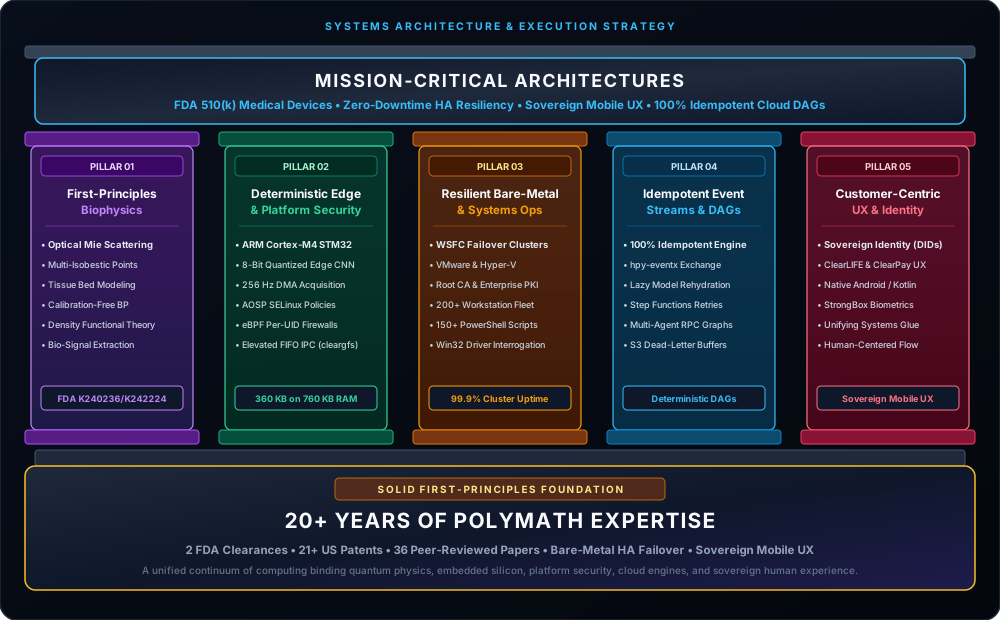
Five Pillars Supporting Mission-Critical Architectures
Resting on 20+ years of polymath engineering foundation across quantum physics, bare silicon, platform security, distributed cloud engines, and sovereign human experience.
First-Principles Transduction & Biophysics
Grounding algorithmic feature spaces in physical invariants. Rather than treating sensor streams as arbitrary numerical arrays, algorithms model the underlying biophysics (Mie scattering, tissue bed absorption, vascular compliance) to achieve calibration-free performance and FDA 510(k) clearances.
Deterministic Edge & Platform Sandboxing
Zero-leakage memory and strict capability isolation. Deploying quantized neural network models within extreme RAM/flash boundaries, and enforcing least-privilege mandatory access control via custom SELinux domain policies, eBPF socket filters, and hardware HSMs.
Resilient Bare-Metal & Systems Operations
Hardware-aware infrastructure designed for continuous uptime. Sub-second active/passive failover clustering, multi-hypervisor virtualization (VMware/Hyper-V), Root CA & enterprise PKI governance, and low-level Win32 hardware register driver interrogation.
Idempotent Event Exchanges & Agent DAGs
Mathematical determinism in distributed cloud backends. NetworkX topological DAG gating, multi-source on-demand model rehydration, timestamp-preserving S3 DLQ buffers, and collaborative multi-agent execution orchestrators.
Customer-Centric UX & Sovereign Identity
Emphasizing user experience as the ultimate glue uniting the entire technical continuum. Building privacy-first native mobile ecosystems (ClearLIFE, ClearPay), self-sovereign decentralized identities (W3C DIDs, Hyperledger Indy), biometric hardware signing, and intuitive human-in-the-loop interfaces that convert deeply complex distributed architectures into seamless, trust-centered user agency.
Areas of High-Leverage Impact & Engineering Roles
Key technical archetypes and leadership capabilities de-risk high-complexity technical ventures.
Principal / Staff Systems Architect
Leading end-to-end technical strategy across deeply interconnected domains bridging firmware, mobile platform security, biophysics feature pipelines, and distributed cloud backends.
Fractional CTO & Technical Co-Founder
De-risking novel, moonshot hardware/software platforms from zero to one. Architecting the initial core tech, hiring key engineers, and setting deterministic architectural foundations.
Medical Device R&D (FDA Clearances)
Directing biomedical algorithm engineering, optical tissue simulation, clinical validation studies, and FDA 510(k) / De Novo regulatory clearance packages for commercial wearable sensors.
Cloud Event Processing & Agent Engines
Architecting high-throughput distributed event streaming systems and idempotent DAG engines to enforce business rules. Accelerating zero-to-one with autonomous multi-agent task execution graphs. Building reliable Lambda@Edge attribution platforms.
Availability & Professional Connections
I am currently Principal Data Scientist and Systems Architect full-time at Happy Health. While not taking on active side commitments, I welcome high-SNR technical discussions, systems-level architecture dialogues, and connections with fellow founders, executives, and engineering peers.