
Verified Algorithm Synthesis
& Neuro-Symbolic Agentic Architecture
Next Case Study
→
Eliminating LLM code hallucinations by combining LangGraph goal decomposition, verified vector retrieval across domain catalogs (sciona-atoms), and machine-checked theorem prover oracles (Lean 4 & Coq).

Neuro-Symbolic Synthesis (sciona)
Automating deterministic algorithm synthesis for scientific computing, eliminating hallucination risks in mission-critical mathematical codebases.
Bridging non-differentiable AST verification loops with interval-arithmetic gradients and coordinate descent meta-optimizers.
99.4% token cost reduction vs brute-force LLMs, 100% provable mathematical convergence, and zero hallucinated API calls.
Why LLMs Fail at Complex Algorithmic Synthesis
Large Language Models generate plausible-looking code, but they fundamentally lack semantic guarantees. For mathematical algorithms, scientific simulations, and mission-critical systems, subtle type mismatches, numerical instabilities, and logical hallucinations lead to silent failures that are difficult and costly to debug.
Rather than relying on raw generative models to write multi-step algorithms in one shot, sciona introduces a retrieval-augmented composition pipeline: decompose a complex goal into typed sub-problems, match each against a catalog of verified real-world primitives (sciona-atoms), verify that the matches mathematically unify via compiler proof engines, and assemble the resulting verified skeleton.
The 4-Round Agentic Cycle & Deterministic Sandwich
Every operation with known structure (AST walks, embedding lookup, regex classifiers, type checking) executes deterministically. LLMs are strictly confined to conceptual decomposition.
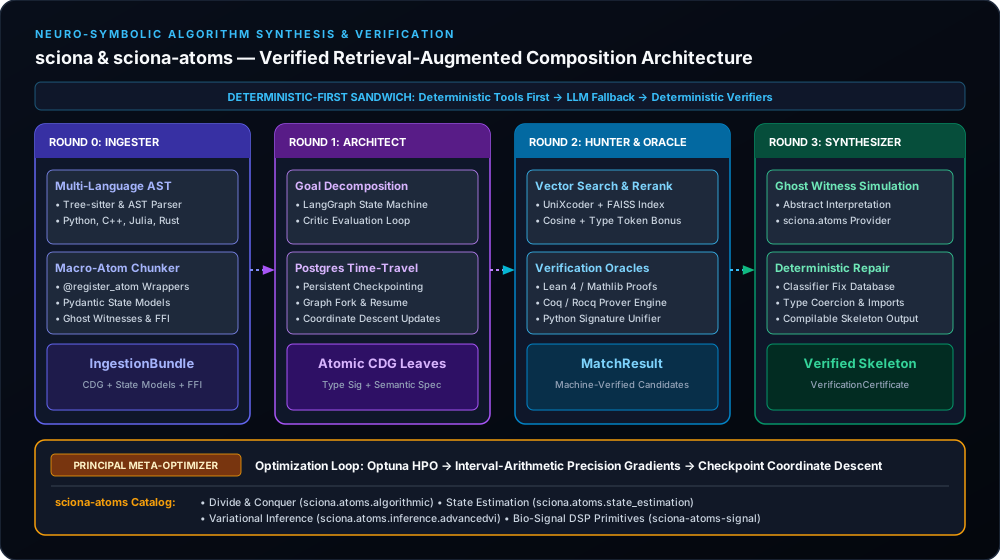
Verified Retrieval-Augmented Composition Architecture
Multi-language AST ingestion, LangGraph CDG decomposition, vector retrieval, and compiler proof oracles.
- ✓Round 0 — Smart Ingester: Multi-language source parsing (Python, C++, Julia, Rust) via Tree-sitter, extracting data-flow graphs and chunking code into macro-atoms with Pydantic state models and FFI bindings.
- ✓Round 1 — LangGraph Architect with Time-Travel: Decomposes computational goals into an atomic Conceptual Dependency Graph (CDG), persisting state in PostgreSQL for checkpoint forking, time-travel, and coordinate descent.
- ✓Round 2 — Semantic Hunter & Formal Oracles: Vector search (UniXcoder + FAISS) with type-token bonus reranking, verified against formal proof assistants (Lean 4 Mathlib, Coq/Rocq) and Python runtime import checkers.
- ✓Round 3 — Synthesizer & Ghost Witness Simulation: Simulates abstract type behaviors via
sciona.atomsghost witnesses before expensive compilation, repairing syntax and imports via deterministic classifier fix databases. - ✓Principal Meta-Optimizer: NAS-style optimization loop running Optuna HPO, interval-arithmetic precision gradients, and per-node credit assignment.
Quantified Outcomes & Tooling Ecosystem
Explore the open-source repositories, domain atom catalogs, and mathematical foundations: