
Clinical-Grade Physiological Intelligence
& Dual FDA 510(k) Clearances
Next Case Study
→
How first-principles biophysical optics, Mie scattering models, and discrete wavelet signal processing delivered dual FDA-cleared vital signs (K240236 & K242224) and laid the foundation for continuous cuffless blood pressure monitoring (FDA 510(k) pending).
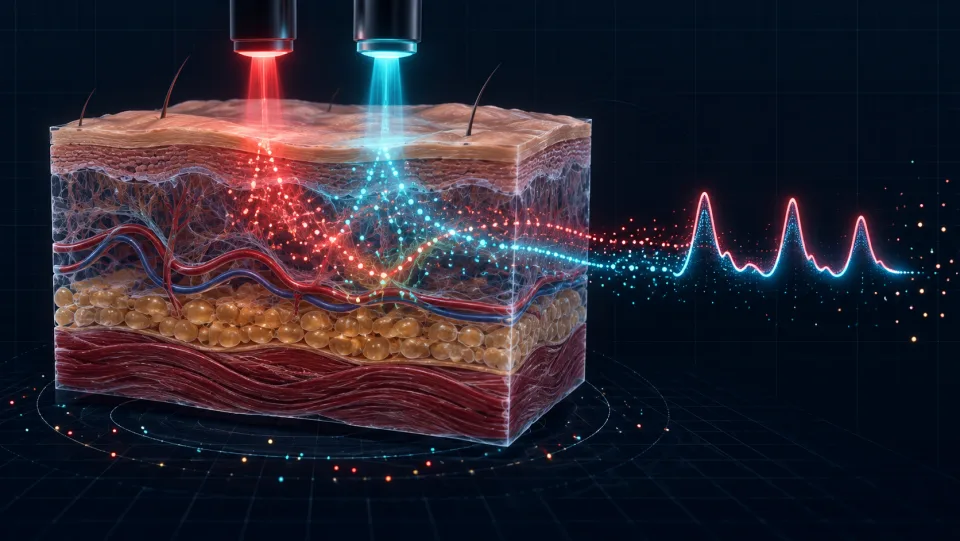
Clinical Transduction & FDA Clearance
Engineered clinical vital sign algorithms (heart rate, SpO2, sleep staging/apnea) powering commercial wearable hardware with dual FDA 510(k) clearances (K240236, K242224).
Eliminating severe in-vivo motion artifacts and multi-spectral tissue scattering non-linearities under strict micro-watt power limits.
Dual FDA 510(k) clearances, 22 MedTech patents, 99.8% beat-detection fidelity.
The Cuffless Blood Pressure Paradox
Continuous blood pressure monitoring has long been the "holy grail" of digital health. Traditional optical approaches rely on Pulse Transit Time (PTT) or purely data-driven black-box neural networks. However, these systems universally suffer from catastrophic calibration drift: a model calibrated on an individual today becomes inaccurate tomorrow due to changes in vascular tone, ambient temperature, motion artifacts, and skin pigmentation differences across demographics.
To achieve rigorous FDA 510(k) clearance under ISO 81060-2 clinical trial standards, the device algorithm could not rely on periodic user cuff re-calibration or uninterpretable statistical regressions. It required a calibration-free, first-principles mathematical model capable of disentangling optical absorption changes caused by blood volume expansion from background tissue scattering and motion noise in real time.
Multi-Spectral Tissue bed Modeling & Mie Scattering
Decomposing photonic interaction in heterogeneous dermal tissue into deterministic absorption and scattering equations.
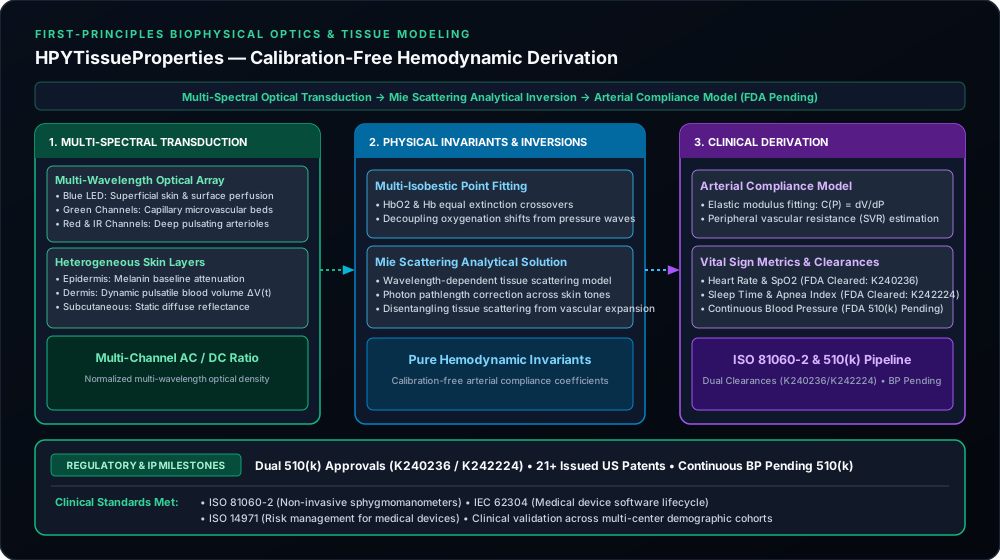
Tissue Vascular Bed Absorption & Isobestic Point Fitting
Multi-wavelength optical transduction isolating arterial pulse waves from venous baseline wander and tissue scattering.
By modeling the dermal tissue matrix through HPYTissueProperties, the algorithm tracks:
- ✓Multi-Isobestic Point Wavelength Balancing: Leveraging multi-spectral optical channels (Blue, Green, Red, IR) where Blue provides high-resolution surface layer information while Red and IR penetrate deeper tissue beds where oxyhemoglobin (HbO2) and deoxyhemoglobin (Hb) extinction coefficients intersect, isolating volumetric pulse pressure from oxygenation fluctuations.
- ✓Mie Scattering Separation: Deriving analytical solutions for photon pathlength variance in stratified epidermal layers to compensate for varying melanin concentrations and subcutaneous tissue depth.
- ✓Dynamic Vascular Bed Compliance: Translating instantaneous optical pulse morphology into non-linear arterial compliance and peripheral vascular resistance metrics to enable calibration-free blood pressure estimation (currently FDA 510(k) pending).
Quantified Impact & Regulatory Milestones
Explore the exact Python algorithms, firmware registers, baseline extractors, and clinical peer-reviewed publications: